
Views: 185 Author: Publish Time:2026-08-19 09:30:00 Origin: Orpinegift
Bulk lanyards must carry a logo clearly, feel comfortable, hold the intended item, and arrive sorted for the event or organization. A useful custom lanyards bulk specification combines material, decoration, dimensions, attachments, badge holder, safety features, packaging, and delivery requirements. This guide helps buyers turn a visual idea into a quote-ready order.
State whether the order is for conferences, trade shows, employee ID, schools, hospitality, healthcare, sports, fundraising, merchandise, or gift packs. Identify the item being carried, duration of wear, audience, distribution method, event date, and destination.
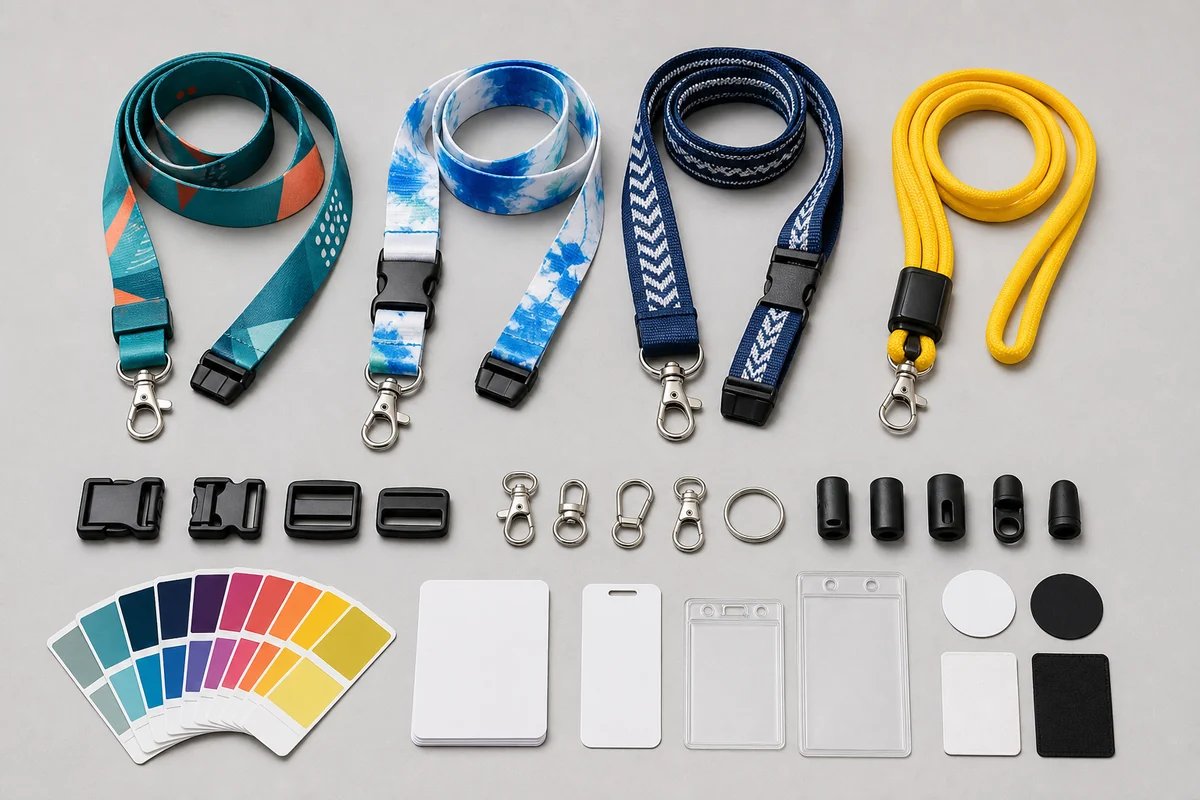
Browse Orpinegift's custom lanyard range to choose a base construction. A lightweight event badge and a set of keys place different demands on width, attachments, and comfort.
| Construction | Visual result | Best questions to ask |
|---|---|---|
| Screen-printed polyester | Clean logos and cost-efficient repeat patterns | Number of colors, print sides, registration, coverage, and edge distance |
| Dye sublimation | Full-color artwork, gradients, and edge-to-edge design | Artwork resolution, color proof, fabric surface, reverse-side appearance, and alignment |
| Woven jacquard | Textured premium branding integrated into the strap | Minimum line thickness, color count, reverse side, edge definition, and hand feel |
| Tubular lanyard | Soft rounded profile and casual appearance | Diameter, print area, seam position, attachment fitting, and logo repeat |
Choose the process according to the artwork and required impression. A photograph or complex gradient usually suits sublimation, while a simplified logo may be clear in screen print or woven construction.
Define finished drop length or total cut length, width, thickness, number of printed sides, and logo orientation. State the finished logo width, repeat distance, and required blank space near stitching, buckles, or safety breaks. Use an actual-size artwork proof to confirm readability.
For double-ended lanyards, wrist straps, short straps, or adjustable styles, provide a diagram showing every segment and attachment. Avoid relying on terms such as standard length when the order supports uniforms, children, or specialized equipment.
Common options include swivel hooks, lobster clips, split rings, bulldog clips, J-hooks, phone tabs, badge reels, and detachable buckles. Confirm attachment material, finish, dimensions, opening, orientation, and connection method. The attachment should fit the badge slot, key ring, card holder, or device without forcing the user to modify it.
Review custom badge and card holders with the lanyard. The badge reel and ID holder sourcing guide explains card orientation, reel length, clips, and program planning.
A neck safety breakaway may be appropriate for certain workplaces, schools, or events. Specify location, component style, opening behavior, and reassembly expectations. A detachable buckle near the lower end allows users to remove keys or badges without taking off the lanyard.
Feature requirements should follow the buyer's risk assessment and local policies. Ask the supplier for representative components and approve operation on the finished sample.
Send vector artwork when available, Pantone or other approved color references, layout direction, print side, logo dimensions, and exact text. Outline fonts or include the required font files. Keep critical artwork away from folds, stitching, clips, and breakaway components.
For sublimation, use a high-resolution file at the correct proportions and include bleed. For woven designs, simplify very fine lines and small lettering. Approve a digital proof, then review a physical sample when color or detail is critical.
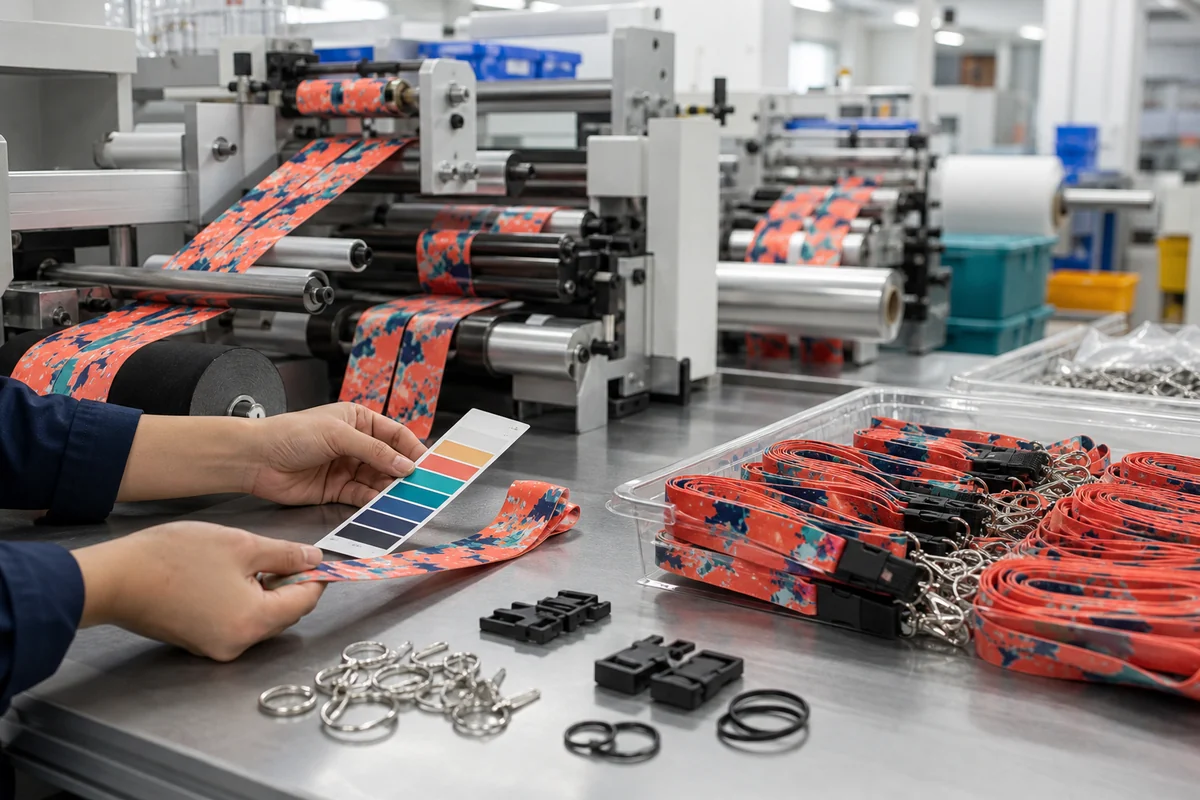
The sample should use the intended material, width, artwork, attachments, safety components, holder, and packing method whenever possible. Measure the lanyard, check comfort, inspect print or weave, operate every attachment, and confirm that the carried item sits in the correct orientation.
Keep an approved sample and signed specification. For repeat orders, state whether the factory should match the previous sample, a new color standard, or updated artwork. Do not assume an old digital image controls all details.
Options include bulk bundling, individual bags, paper bands, boxes, sets with holders, and kits sorted by team, role, location, or event. If variable names, badge inserts, or multiple artwork versions are involved, provide a controlled data file and packing matrix.
Work backward from the in-hand date, not the event date. Include artwork approval, sample production, revisions, mass production, inspection, shipping, customs, internal distribution, and a schedule buffer.
Sample across cartons and artwork versions. Check dimensions, color, print position, logo repeat, edge quality, weaving, stitching, safety break operation, attachment finish, holder orientation, count, and packaging. Record findings by SKU and compare them with the approved sample.
Inspect any sharp edges, loose parts, stains, mixed components, unreadable logos, or incorrect badge orientation. For programs with several roles or colors, verify assortment quantities before shipment.
Send artwork, quantity, material or process, width, length, print sides, attachments, holder dimensions, safety requirements, packaging, destination, and required delivery date. Explore additional custom promotional products, then request a bulk custom lanyard quote for sampling, production, inspection, and delivery planning.